Towards 2030: Sustainable Development Goal 3: Good Health and Wellbeing. A Sociological Perspective

Cover image for Research Topic "Towards 2030: Sustainable Development Goal 3: Good Health and Wellbeing. A Sociological Perspective"
78kviews
Editorial17 June 2025
Editorial: Towards 2030: sustainable development goal 3: good health and wellbeing. A sociological perspective

is a provisional file, not the final typeset article This Research Topic explores the third Sustainable Development Goal (SDG) to "ensure healthy lives 29 and promote wellbeing for all at all ages," highlighting the severe impact of the COVID-19 pandemic. 30The pandemic has threatened to reverse prior improvements in maternal and child health, immunization 31 coverage, and reductions in communicable and non-communicable disease mortality while also 32 disrupting essential health services, shortening life expectancy, and worsening mental health issues and 33 healthcare access inequalities. This collection contains studies examining how social stratification, 34 geography, and culture affect health, aiming to inform policymakers on developing equitable public 35 health policies to address disparities and improve wellbeing. 36The collection " Raji and Demehin, 2023); (4) integrated innovation combining ideas from the fields the environmental 110 policy, social policy, and health policy (see Klimczuk, Klimczuk-Kochańska, and Felix, 2022); and (5) 111 privacy and ethical issues related to e-health solutions such as telemedicine platforms, mobile health 112 apps, and wearable health devices (see Wyllie et al., 2022).

2,246 views

Alignment and specifics of Brazilian health agencies in relation to the international premises for the implementation of digital health in primary health care: a rhetorical analysis
REVIEW
8 February 2024
Alignment and specifics of Brazilian health agencies in relation to the international premises for the implementation of digital health in primary health care: a rhetorical analysis
Aguinaldo José de Araújo, 6 more and Severina Alice da Costa Uchôa

5,688 views

8 citations

ORIGINAL RESEARCH
26 January 2024
Experiences and lessons from structural interventions against COVID-19 in Addis Ababa, Ethiopia
Kibur Engdawork, 3 more and Getnet Tadele
Introduction: Fighting pandemics like COVID-19 requires implementing successful structural interventions that attempt to change the social and political environments to increase adherence to preventive behaviour among community members. However, studying structural interventions during pandemics and their challenges remains to be uncharted territory in developing countries. Objectives: Given this, we documented the experiences of implementing such interventions in Ethiopia with the aim of drawing lessons for future efforts to fight similar outbreaks in resource limited and low-income settings. Methods: We conducted a qualitative study between September and October 2021. Data were collected through face to face and telephone interviews from purposefully selected stakeholders from government and private sectors engaged in social interventions to prevent COVID-19. The systematization and the analysis of the data were conducted with MAXQDA 2020 software. Results: Ethiopia tried to respond to the COVID-19 pandemic through structural and social interventions. This included: developing national policy and guidelines, mainstreaming COVID-19 interventions to local organizations, implementing capacity development programs, and developing strategies to engage the community, through traditional institutions, in intervention activities. In addition, a mass communication approach was used to deliver risk messages. This yielded a promising result in slowing down the spread of COVID-19 in the most populated city of the country. On the other hand, competing interests, misconceptions, capacity constraints among 2 professionals and organizations, limited legislation enforcing capacity and lack of motivation for change from the community side affected the implementation and the outcomes of interventions. Conclusion: Stakeholder shall take these challenges into consideration when designing and implementing structural interventions to contain disease outbreaks effectively. The study implied that attempts to withstand pandemic in low-and middle-income settings shall successfully utilize local resources, act swiftly when pandemics outbreak and adjust themselves to the dynamic challenges and limitations of structural interventions.

5,278 views

4 citations

ORIGINAL RESEARCH
11 January 2024
Implementing a social innovation for community-based peer support for immigrant mothers in Sweden: a mixed-methods process evaluation
Per Kåks, 3 more and Sibylle Herzig van Wees

4,119 views

7 citations

ORIGINAL RESEARCH
31 October 2023
Social determinants of health and lung cancer surgery: a qualitative study
Dede K. Teteh, 8 more and Virginia Sun
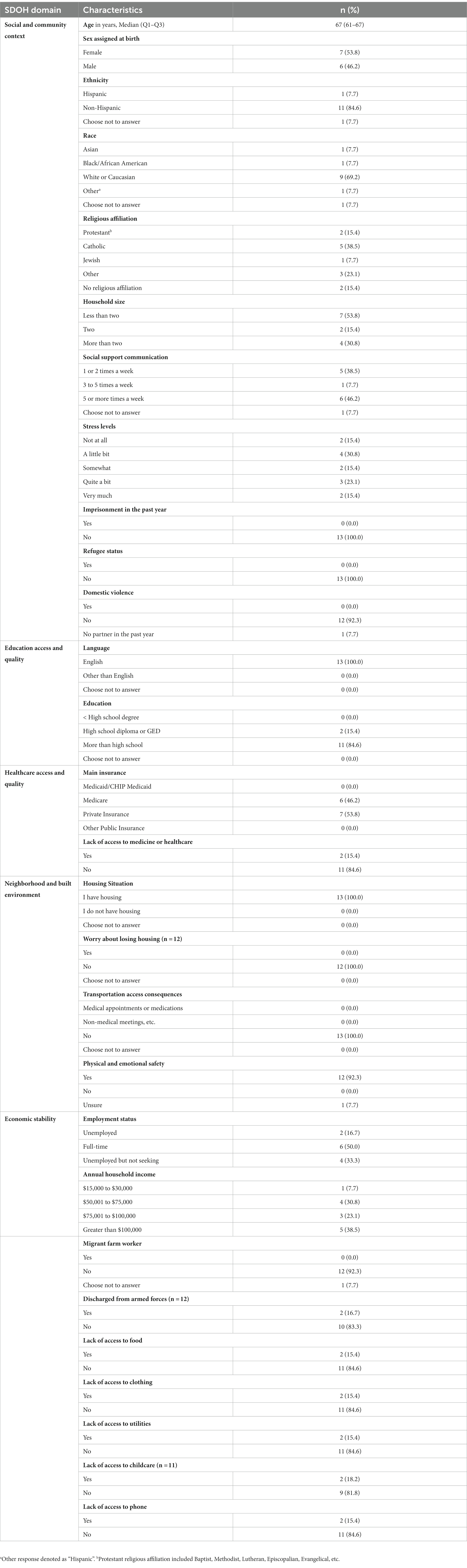
Social determinants of health (SDOH) are non-clinical factors that may affect outcomes of cancer patients. The purpose of this study was to describe the influence of SDOH factors on quality of life (QOL)-related outcomes for lung cancer surgery patients. Methods: Thirteen patients enrolled in a randomized trial of a dyadic self-management intervention were invited and agreed to participate in semi-structured key informant interviews at study completion (3 months post-discharge). Conventional content analysis approach was used to identify codes and themes that were derived from the interviews. Independent investigators coded the qualitative data, which were subsequently confirmed by a second group of independent investigators. Themes were finalized and discrepancies were reviewed and resolved. Results. Six themes, each with several subthemes emerged. Overall, most participants were knowledgeable about the concept of SDOH and perceived that provider awareness of SDOH information was important for the delivery of comprehensive care in surgery. Some participants described financial challenges during treatment that were exacerbated by their cancer diagnosis and resulted in stress and poor QOL. The perceived impact of education varied and included its importance on navigating the healthcare system, decision-making on health behaviors, and more economic mobility opportunities. Some participants experienced barriers to accessing healthcare due to insurance coverage, travel burden, and the fear of losing quality insurance coverage due to retirement. Neighborhood and built environment factors such as safety, air quality, access to green space, and other environmental factors were perceived as important to QOL. Social support through families/friends and spiritual/religious communities were perceived as important to postoperative recovery. Discussion: Among lung cancer surgery patients, SDOH factors can impact QOL and patient’s survivorship journey. Importantly, SDOH should be assessed routinely to identify patients with unmet needs across the five domains. SDOH-driven interventions are needed to address these unmet needs and to improve the QOL and quality of care for lung cancer surgery patients.
Social determinants of health and lung cancer surgery: a qualitative study

7,048 views

21 citations

Health seeking behavior of street connected children in Addis Ababa, Ethiopia
ORIGINAL RESEARCH
7 August 2023
Health seeking behavior of street connected children in Addis Ababa, Ethiopia
Bewunetu Zewude, 2 more and Getnet Tadele

7,474 views

10 citations

STUDY PROTOCOL
22 June 2023
Role of personal aptitudes as determinants of incident morbidity, lifestyles, quality of life, use of health services, and mortality (DESVELA cohort): quantitative study protocol for a prospective cohort study in a hybrid analysis
Ruth Martí-Lluch, 11 more and the DESVELA Cohort Investigators

5,046 views

7 citations

CONCEPTUAL ANALYSIS
25 November 2022
Socio-historical analysis of the social importance of pharmacovigilance
Juan R. Coca, 1 more and Gema Esteban Bueno
Pharmacovigilance is a scientific discipline that has changed a lot in recent years and is of great social importance. The case of the so-called sulfonamide elixir showed society the importance of this discipline. Since then, pharmacovigilance has evolved into a scientific discipline with a strong social character. In this paper, a historical review is made of several paradigmatic examples of this discipline to reflect on what pharmacovigilance could be like finally. We conclude that this discipline could be more closely related to other areas of the social sciences, which would help to promote a more democratic social environment taking into account the needs of individuals and social groups.

5,591 views

6 citations