WJ
william j scheideler
Thayer School of Engineering, Dartmouth College
Hanover, United States
6,173
Total downloads
40k
Total views and downloads
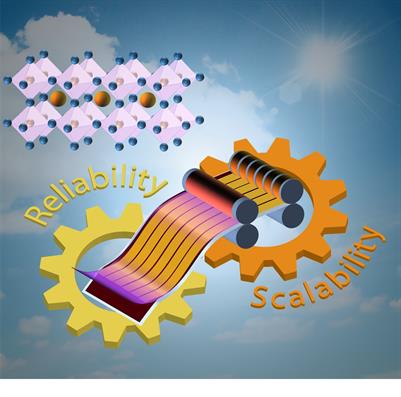
Metal halide perovskites are an earth-abundant class of solar absorbers with intrinsic optoelectronic potential for driving high-efficiency single junction and tandem photovoltaics. Their explosive recent development could mark an inflection point in renewable energy technologies if fundamental challenges related to scaling and stability are addressed. Cost models for perovskite PVs hinge not only on module-level efficiency, but also on the assumed service lifetime (5 years? 20 years?), a point which demands the utmost attention ahead of continued investment in this technology. Groups the world over have realized that scale-up of metal halide perovskites is a non-trivial undertaking, demanding unprecedented control of material synthesis, solution-deposition, and annealing processes over large areas, bounded by unique perovskite material constraints such as its thermal and moisture sensitivity. These challenges demand that we carefully consider whether recent sub-cm-scale materials and device architectures can satisfy demands for uniformity and reliability at the meter-scale, module-level.
Perovskite devices are susceptible to degradation and failure due to their inherent thermomechanical fragility, generally exhibiting low fracture energy. Thermomechanical stresses are inherent to mass-manufacturing processes. R2R deposition and annealing, as well as encapsulation processes can contribute both temporary and permanent stress in perovskite devices with the potential to cause defects at the material and device level. Up-scaling depends critically on understanding the implications of microscale defects for macroscale device and module reliability. The goal of this Research Topic is to explore these deeper connections between scaling and reliability in perovskite solar cells and modules. For example, how do scalable processes such as printing, R2R coating, and rapid annealing impact the intrinsic reliability of perovskites? What is the impact of monolithic integration on operational stability? What inherent challenges are encountered when scaling planar vs mesoporous architectures, inorganic or organic transport layers? Is fully vacuum-free processing achievable for large area perovskite modules?
Contributions to this Research Topic should broadly address perovskite scaling and reliability, exploring their interrelatedness. Works that explore these topics may include studies addressing themes such as:
• Reliability of flexible perovskite cells and modules.
• What reliability challenges exist for non-traditional solar energy applications to electric vehicles and wearable devices?
• Impact of monolithic integration on module reliability (laser scribing vs mechanical scribing).
• Reliability of perovskite-perovskite tandems and silicon-perovskite tandem PVs.
• Scalability of large area encapsulation strategies for perovskite modules.
• Design of high-speed printing processes – contact vs non-contact coating methods.
• Rapid, large-area characterization methods suitable for inline monitoring and control of PVSK manufacturing.
• Scalable methods for large area organic or inorganic charge transport materials.
• Design of reliable and scalable contact electrodes for perovskite PVs.
Keywords: perovskite photovoltaics, scalability, reliability, R2R printing, flexible solar cells
Important note: All contributions to this Research Topic must be within the scope of the section and journal to which they are submitted, as defined in their mission statements. Frontiers reserves the right to guide an out-of-scope manuscript to a more suitable section or journal at any stage of peer review.
