115kviews
Editorial17 October 2019
Editorial: Smoking and Schizophrenia

The association between cigarette smoking and schizophrenia is well established. Rates of smoking amongst people with schizophrenia are markedly higher than in the general population. In many countries where public health campaigns have reduced the overall prevalence of smoking amongst the general population, there has been little impact on rates of smoking amongst people with schizophrenia. The series of articles in this collection aims to understand the reason for the high smoking rates amongst people with schizophrenia, as well as to explore both barriers and facilitators towards smoking cessation in this vulnerable group.The reason why people with schizophrenia do smoke at such high rates is complicated and include psychosocial factors, milieu issues such as initiation of smoking on inpatient wards (albeit many have now banned smoking) as well as social affiliation. However, there is more to it than this and the effects of nicotine on the symptoms of schizophrenia as well as cognition need to be factored into this understanding. The paper by Lucatch et al. tackles the topic of neurobiological underpinnings of tobacco smoking in people with schizophrenia, with an overview of how nicotine may serve to ameliorate some of the perturbations in dopaminergic, glutamatergic and GABAergic pathways. These authors conclude that an understanding of these neurobiological parameters is important in treatment paradigms where the understandings can be integrated into psychosocial interventions. A case control study presented by Stramecki et al. explores the association between cigarette smoking and cognitive function in people with schizophrenia and controls without schizophrenia; roughly half in each group were cigarette smokers. A comprehensive neuropsychological battery was administered, with results suggesting that cigarette smoking is associated with impairment in delayed memory in people with schizophrenia. The authors noted that longitudinal studies are required to establish causal associations.Scott and colleagues address a very interesting issue of whether smoking is a cumulative causal factor for schizophrenia and related disorders. They provide an overview of existing studies which have addressed this issue and conclude that despite methodological shortcomings (including failure to adjust for certain confounders such as childhood trauma or prenatal tobacco exposure), there is "substantial though inconclusive evidence supporting a causal relationship between tobacco smoking and an increased risks of schizophrenia spectrum disorder". The potential public health implications of this finding are profound.The bulk of the rest of the articles in this collection address the issue of smoking cessation and how to help smokers with schizophrenia to quit. Lum and colleagues performed a comprehensive systematic review of the literature on psychosocial barriers and facilitators to smoking cessation in people with schizophrenia. They included 23 articles: 20 were quantitative and three qualitative. In terms of barriers to smoking cessation, cravings and addiction were the most strongly endorsed, followed by the perception that negative symptoms worsened when quitting smoking. The review also showed that people with schizophrenia believed that smoking helps them manage stress and maintain social relationships; health concerns were seen as reasons to quit smoking. These important findings are echoed and expanded by Cocks et al. who bring a "lived experience lens" to this particular issue. The authors suggest that a recovery orientated approach could integrate treatments which have an evidence base in terms of smoking cessation.A somewhat more challenging view is provided by Twyman et al. in a qualitative study of community mental health staff and consumers about the role of tobacco in their lives as well as the impact of these issues on smoking cessation. Themes identified by staff included some degree of fatalism in that they saw people continuing to smoke as their choice rather than an addiction and identified a tension between offering smoking cessation programs and "free choice". Consumers saw smoking as part of their life and social networks and as a way of "maintaining control". Social support to quit was an important theme. These authors conclude that education and training for staff within community mental health services is imperative.In terms of specific programs addressing smoking cessation, Curtis et al. assessed the uptake and impact of a smoking cessation program in young people with a psychotic illness. Of young people who were eligible for the program, 41 (67%) engaged in the program; a third of these had the full intervention and further third received only a brief intervention. Nearly half of those receiving the full intervention and a quarter of those receiving the brief intervention dropped out; 28% of those completing the full intervention achieved smoking cessation. The authors emphasised the potential for impacting smoking behaviours in youth in the early phases of severe mental illness.Baker and colleagues outline a current randomised controlled trial with smokers with a severe mental illness. A brief peer delivered intervention around smoking is being compared to an intervention which includes the same brief intervention with proactive referral to a tailored cognitive behavioural intervention offered by "Quitline", along with nicotine replacement therapy. This ambitious study aims to recruit nearly 400 smokers over three years. The trial asks an important question as to whether a "minimal intervention" can address smoking amongst people with schizophrenia. In such trials it is important also to have an assessment of cost, and a companion paper by Sweeney et al. provides the protocol for the economic evaluation of this Quitlink program.Seeking to strengthen future research efforts, Baker and colleagues present the perspectives of five leading international experts, by asking them "What are the top three research ideas we need to prioritize in order to advance the field of reducing smoking amongst people with schizophrenia?" The broad priorities identified were: (i) deeper understanding about the associations between smoking, smoking cessation and symptomatology; (ii) targeted, adaptive and responsive behavioural interventions evaluated by smarter methodologies; and (iii) improvements in delivery of interventions, especially within health care settings. They strongly suggested that efforts should be made to establish a collaborative international research agenda, with partnerships between bodies overseeing mental health treatment and smoking cessation. We trust this compilation of articles will assist in these important domains.

11,614 views

10 citations

CLINICAL STUDY PROTOCOL
3 September 2019
Protocol for an Economic Evaluation of the Quitlink Randomized Controlled Trial for Accessible Smoking Cessation Support for People With Severe Mental Illness

4,754 views

4 citations

Introduction: People living with schizophrenia smoke at much higher rates than the general population, and find it more difficult to quit. To date, lived experience has received little attention from researchers. Personal recovery perspectives may generate further insights into established psychosocial barriers and enablers of smoking cessation. Methods and Results: A lived experience account is provided by one of our authors that places the current evidence in context, and highlights the role of marginalisation and stigma in reinforcing smoking. Key concepts from the personal recovery paradigm, such as connectedness, hope and empowerment are discussed. The relevance of these factors and the value of shared lived experience in challenging stigma, marginalisation and low expectations demonstrates the contribution that peer support can offer to support smoking cessation. Conclusions: Recovery-oriented approaches when integrated with existing evidence-based treatments designed to meet the needs of people living with schizophrenia have potential to improve outcomes by helping to take a more holistic approach to break down barriers and facilitate increased uptake of treatment and support. Further research to evaluate the effectiveness of integrated approaches is warranted.

8,688 views

11 citations

ORIGINAL RESEARCH
17 July 2019
‘They’re Going to Smoke Anyway’: A Qualitative Study of Community Mental Health Staff and Consumer Perspectives on the Role of Social and Living Environments in Tobacco Use and Cessation
Laura Twyman, 11 more and Philippa Boss

7,997 views

15 citations

Although tobacco smoking is very common among people with schizophrenia and has devastating effects on health, strategies to ameliorate the risk are lacking. Some studies have reported promising results yet quit rates are much lower than in the general population. There is a need to advance research into smoking cessation efforts among people with schizophrenia. We posed the following question to five leading international experts in the field: “What are the top three research ideas we need to prioritize in order to advance the field of reducing smoking amongst people with schizophrenia?” They identified three broad priorities: (i) deeper understanding about the relationship between smoking, smoking cessation and symptomatology; (ii) targeted, adaptive and responsive behavioural interventions evaluated with smarter methodologies; and (iii) improvements in delivery of interventions. Efforts should be made to establish a collaborative international research agenda.

4,671 views

4 citations

Neurobiological Determinants of Tobacco Smoking in Schizophrenia
REVIEW
6 December 2018
Neurobiological Determinants of Tobacco Smoking in Schizophrenia
Aliya M. Lucatch, 3 more and Tony P. George
Purpose of review: To provide an overview of the underlying neurobiology of tobacco smoking in schizophrenia, and implications for treatment of this co-morbidity. Recent findings: Explanations for heavy tobacco smoking in schizophrenia include pro-cognitive effects of nicotine, and remediation of the underlying pathophysiology of schizophrenia. Nicotine may ameliorate neurochemical deficits through nicotine acetylcholine receptors (nAChRs) located on the dopamine, glutamate and GABA neurons. Neurophysiological indices including electroencephalography, electromyography, and smooth pursuit eye movement paradigms may be biomarkers for underlying neuronal imbalances that contribute to the specific risk of tobacco smoking initiation, maintenance and difficulty quitting within schizophrenia. Moreover, several social factors including socioeconomic factors and permissive smoking culture in mental health facilities, may contribute to the smoking behaviours (initiation, maintenance and inability to quit smoking) within this disorder. Summary: Tobacco smoking may alleviate specific symptoms associated with schizophrenia. Understanding the neurobiological underpinnings and psychosocial determinants of this comorbidity may better explain these potential beneficial effects, while also provide important insights into effective treatments for smoking cessation.

13,299 views

48 citations

Evidence of a Causal Relationship Between Smoking Tobacco and Schizophrenia Spectrum Disorders
REVIEW
20 November 2018
Evidence of a Causal Relationship Between Smoking Tobacco and Schizophrenia Spectrum Disorders
James G. Scott, 4 more and Antti Mustonen
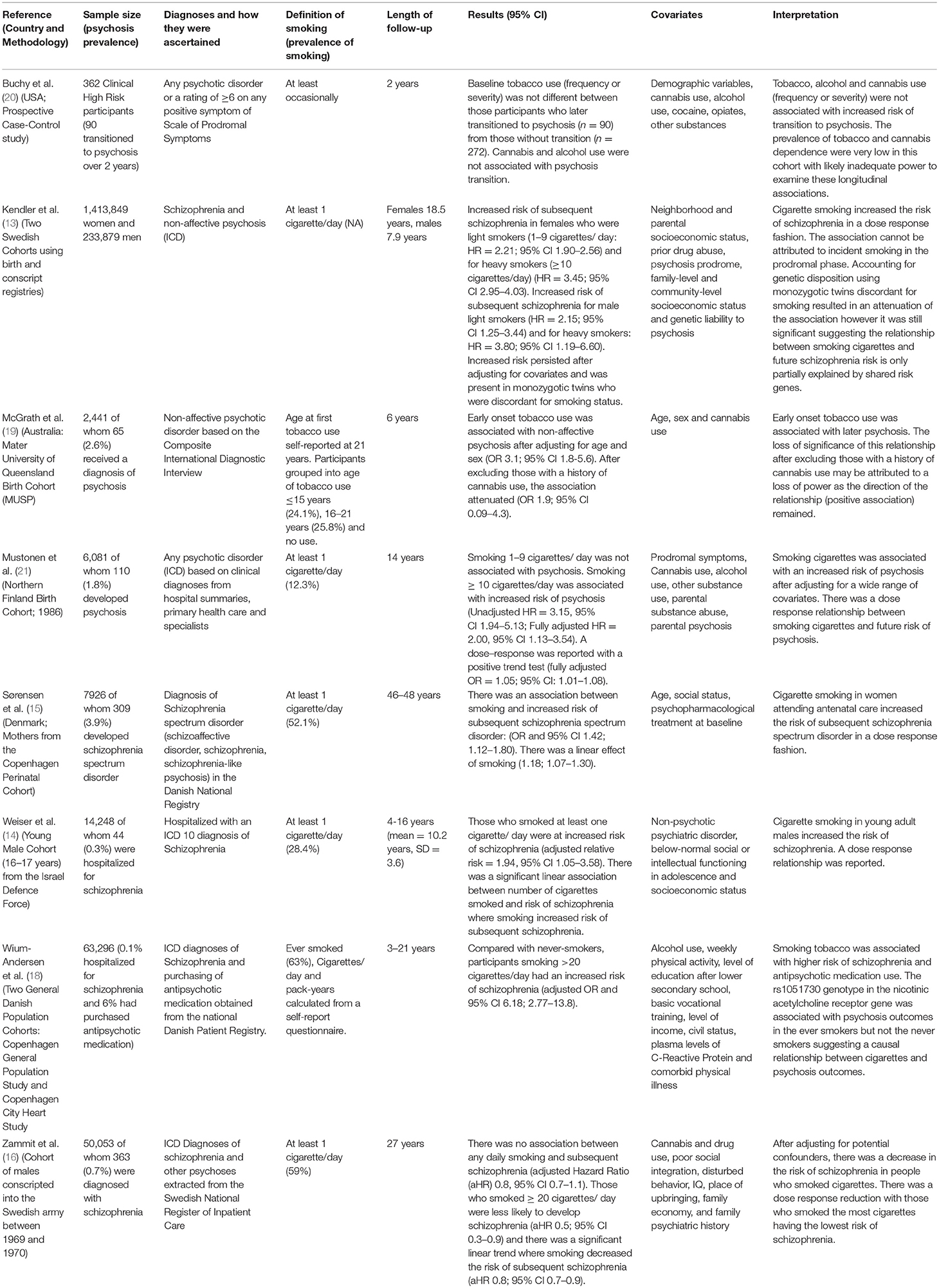
There has been emerging evidence of an association between tobacco smoking and schizophrenia spectrum disorders. Two meta-analyses have reported that people who smoke tobacco have an approximately twofold increased risk of incident schizophrenia or psychosis, even after adjusting for confounding factors. This study aimed to critically appraise the research which has examined the association between tobacco smoking and schizophrenia spectrum disorders against the Bradford Hill criteria for causality, to determine the strength of the evidence for a causal relationship. Eight longitudinal studies (seven cohort studies and one case control study) were identified which examined tobacco smoking as an exposure and psychosis as an outcome. All seven cohort studies were assessed as being of high quality using the Newcastle-Ottawa Scale. Six of the eight studies found a statistically significant positive association between tobacco smoking and onset of schizophrenia spectrum disorder. These studies reported a consistent association with a moderate to large effect size and a dose response relationship. The studies adjusted for multiple potential confounders including age, sex, socioeconomic status, shared genetic risk, prodromal symptoms and comorbid cannabis and other substance use. The studies did not adjust for exposure to childhood trauma or prenatal tobacco. There was substantial though inconclusive evidence supporting a causal relationship between tobacco smoking and increased risk of schizophrenia spectrum disorders. If a causal relationship does exist, nicotine is most likely responsible for this association. This raises serious public health concerns about the increasing use of e-cigarettes and other products, particularly by adolescents whose nicotine use may increase their risk of schizophrenia spectrum disorders. Research is urgently needed to examine the association between e-cigarette use and incident psychosis, particularly in adolescents and young adults.

33,329 views

55 citations

Background: People living with schizophrenia are less likely to quit smoking compared with the general population and people living with other psychiatric disorders. Understanding the psychosocial barriers to smoking cessation is important for designing effective smoking cessation interventions. We aimed to systematically review research examining psychosocial barriers to smoking cessation in people living with schizophrenia. Methods: We followed the PRISMA statement to conduct a systematic literature review examining psychosocial barriers to smoking cessation in people living with schizophrenia. We searched EMBASE, Medline, PsycINFO, and CINAHL databases from inception to 14 June 2018 to identify relevant articles. We included peer-reviewed original research articles that examined psychosocial barriers to smoking cessation, as well as factors associated with maintenance of smoking habits in people living with schizophrenia spectrum disorders. Qualitative, quantitative, or mixed-methods study designs were included. Three authors screened titles, abstracts, and full-texts using the eligibility criteria. We conducted a narrative synthesis of the data to account for the heterogeneity of study designs. We analyzed qualitative and quantitative studies separately. Results: We identified 685 studies from our systematic search and screened the full-text of 134 articles. The final set of articles included 24 articles, of which 21 had quantitative designs and 3 had qualitative designs. The most commonly cited barrier to smoking cessation in people living with schizophrenia was cravings and addiction, followed by a perceived increased risk of negative affect associated with quitting smoking. People living with schizophrenia reported smoking to manage stress and to maintain social relationships, reducing their likelihood of quitting. People living with schizophrenia were found to be less likely to receive cessation support from health professionals than smokers without schizophrenia. Conclusions: Overall, it appears that people living with schizophrenia experience a wide range of barriers to smoking cessation. The influence of these barriers on smoking cessation likelihood may be greater among people living with schizophrenia than people without psychiatric disorders. Health professionals play an important role in smoking cessation for people living with schizophrenia and should support quitting in this vulnerable population. The barriers identified in this review can inform the development of targeted smoking cessation interventions.

9,279 views

44 citations