
Nutritional Physiology of Aquacultured Species

76kviews
Editorial12 January 2023
Editorial: Nutritional physiology of Aquacultured species
Mohamed Salah Azaza, Helena Peresand Serhat Turkmen

intestinal morphology, decreased intestinal digestive and absorptive enzyme activities, and caused 37 poor nutrient digestibility and growth performance in juvenile largemouth bass. In fact, the adverse 38 effects of guar gum are closely related to its viscous level, and high viscous guar gum adversely 39 affects the rearing performance of juvenile largemouth bass. 40 41In addition to the above-mentioned fish species, two investigations were conducted on Pacific white 42 leg shrimp (Litopenaeus vannamei), considered the most important farmed crustacean species. of P. f. martensii was higher than that of P. maxima. Irrespective of the microalga species, RGR was 124 higher when fed with a microalgae bend than with a single microalga. Amylase, cellulase, lipase, and 125 pepsin activity was higher in P. f. Martensii than with P. maxima fed with the same diets. 126 127The papers presented in this Research Topic and conducted on diverse species highlight the 128 usefulness of the physiologic approaches to deepen knowledge in feeding farmed aquatic organisms. 129This helps fish nutritionists to tailor and improve the nutritional profile of the diet and hence to 130 provide more adequate and healthy diets for fish. We sincerely thank all authors and reviewers for 131 their valuable contribution that made the publication of this Research Topic possible. 132

Author Contributions 133
1,830 views

2 citations

ORIGINAL RESEARCH
8 September 2022
Positive effects of replacing commercial feeds by fresh black soldier fly (Hermetia illucens) larvae in the diets of Pacific white shrimp (Litopenaeus vannamei): Immune enzyme, water quality, and intestinal microbiota
Yuhang He, 7 more and Yusheng Jiang

6,181 views

36 citations

ORIGINAL RESEARCH
12 August 2022
Effect of dietary soybean meal on growth performance, apparent digestibility, intestinal digestive enzyme activity and muscle growth-related gene expression of Litopenaeus vannamei
Kai Peng, 6 more and Wen Huang

5,235 views

23 citations

ORIGINAL RESEARCH
5 August 2022
Effects of Different Viscous Guar Gums on Growth, Apparent Nutrient Digestibility, Intestinal Development and Morphology in Juvenile Largemouth Bass, Micropterus salmoides
Yu Liu, 8 more and Beiping Tan

4,118 views

24 citations

ORIGINAL RESEARCH
28 July 2022
Biochemical features and modulation of digestive enzymes by environmental temperature in the greater amberjack, Seriola dumerili
Carmen Navarro-Guillén, 1 more and Erick Perera

9,716 views

39 citations

Growth Performance, Immune-Related and Antioxidant Genes Expression, and Gut Bacterial Abundance of Pacific White Leg Shrimp, Litopenaeus vannamei, Dietary Supplemented With Natural Astaxanthin
ORIGINAL RESEARCH
23 June 2022
Growth Performance, Immune-Related and Antioxidant Genes Expression, and Gut Bacterial Abundance of Pacific White Leg Shrimp, Litopenaeus vannamei, Dietary Supplemented With Natural Astaxanthin
Abdallah Tageldein Mansour, 5 more and Zaki Z. Sharawy
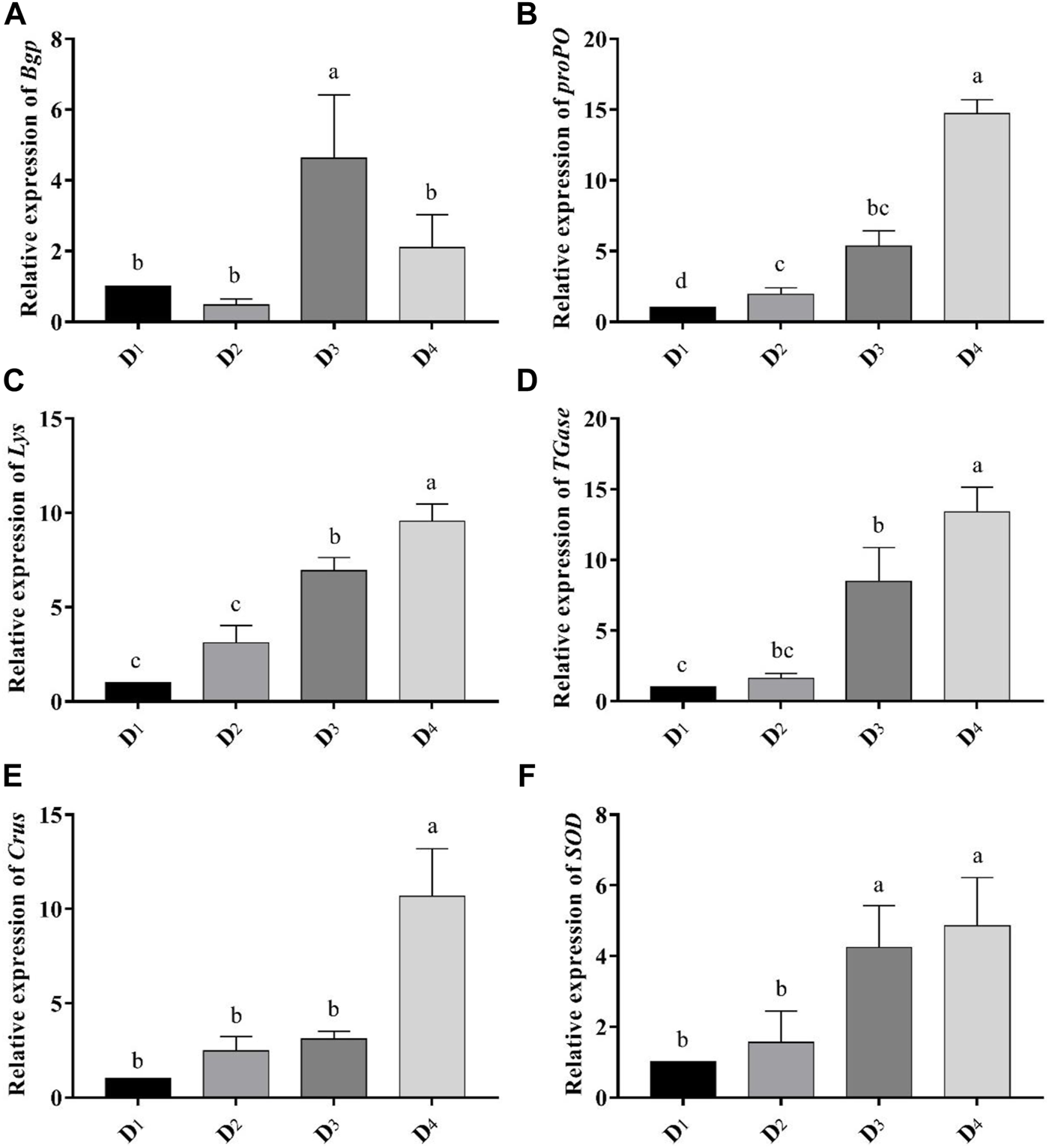
The current study examines the effect of dietary supplementation of ethanolic extract of Arthrospira platensis NIOF17/003, which is mainly natural astaxanthins (97.50%), on the growth performance, feed utilization, bacterial abundance, and immune-related and antioxidant gene expressions of the Pacific white leg shrimp, Litopenaeus vannamei. A total of 360 healthy L. vannamei postlarvae (0.19 ± 0.003 g) were divided into four groups (0, 2, 4, and 6 g natural astaxanthins/kg diet) each in three replicates, at an initial density of 30 PLs per tank (40 L capacity). The shrimp were fed the tested diets three times a day at a rate of 10% of their total body weight for 90 days. Diets supplemented with different astaxanthin levels significantly improved shrimp growth performance and feed conversion ratio compared to the control diet. No significant differences were observed in survival rates among all experimental groups. The immune-related genes (prophenoloxidase, lysozyme, beta-glucan binding protein, transglutaminase, and crustin) mRNA levels were significantly upregulated in groups fed with different concentrations of the natural astaxanthins in a dose-dependent manner. The prophenoloxidase gene is the highest immune-upregulated gene (14.71-fold change) in response to astaxanthin supplementation. The superoxide dismutase mRNA level was significantly increased with increasing dietary astaxanthin supplementation. In addition, increasing astaxanthin supplementation levels significantly reduced the count of heterotrophic bacteria and Vibrio spp. in the culture water and shrimp intestine. Overall, the current results concluded that diet supplementation with natural astaxanthin, extracted from Arthrospira platensis, enhanced the growth performance, immune response, and antioxidant status of L. vannamei.

7,864 views

63 citations

ORIGINAL RESEARCH
28 April 2022
Betaine Regulates the Production of Reactive Oxygen Species Through Wnt10b Signaling in the Liver of Zebrafish
Ao Li, 4 more and Qiuxiang Pang

3,291 views

13 citations

ORIGINAL RESEARCH
29 November 2021
Effects of Glutathione on Growth, Intestinal Antioxidant Capacity, Histology, Gene Expression, and Microbiota of Juvenile Triploid Oncorhynchus mykiss
Chang’an Wang, 7 more and Yuhong Yang

6,975 views

24 citations